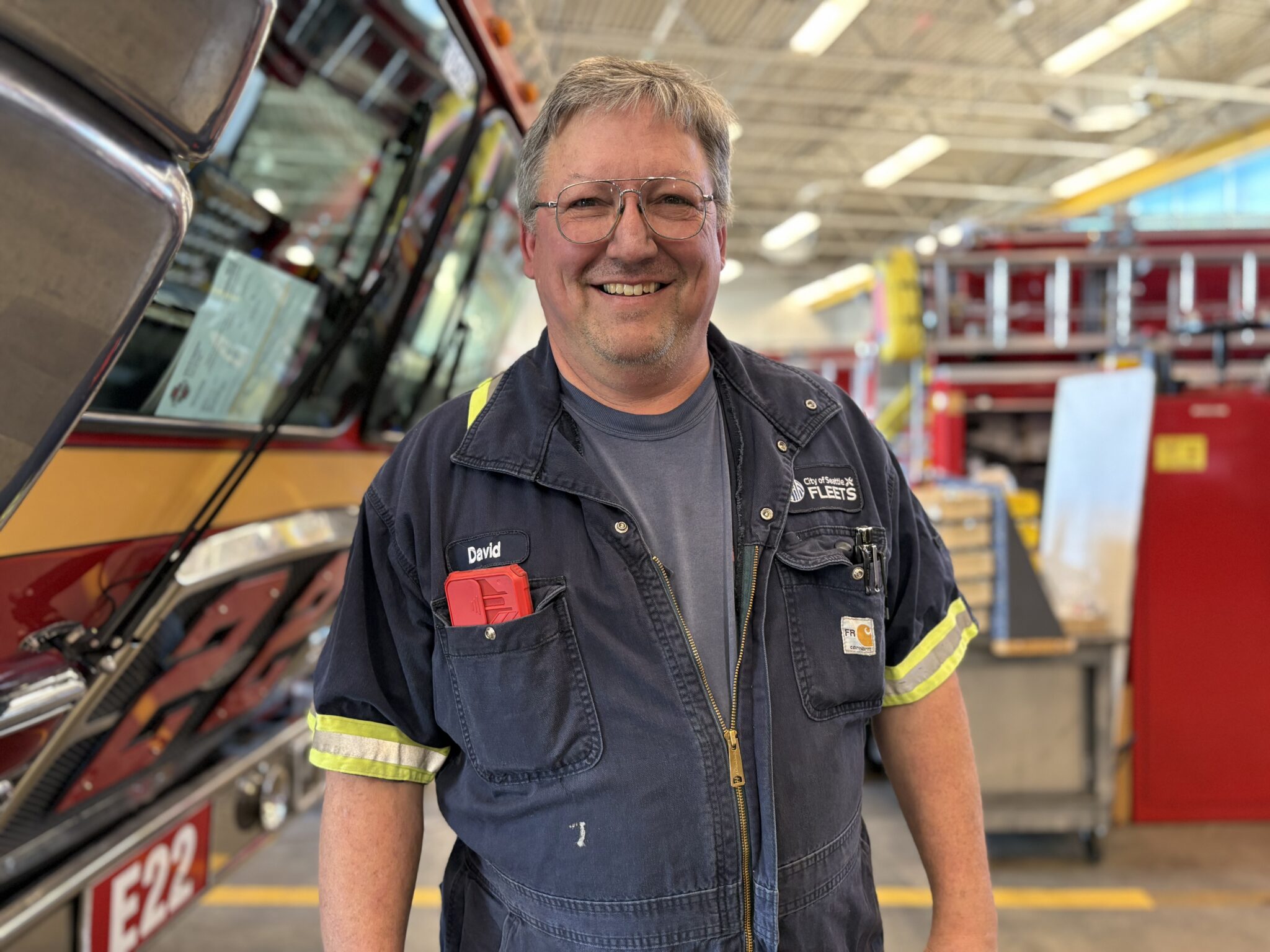
 Fleet Management employee Dave Cress has dedicated over 45 years to the City and helps keep Seattle fire engines running.
 Before he ever turned a wrench on a fire engine, David Cress was a kid who liked to figure out how things worked. During summers on his grandparents’ 20-acre farm east of Bellingham, he repaired the broken clocks his grandmother collected while antiquing.
So, it wasn’t surprising when a high school aptitude test his junior year showed he was suited for heavy‑duty diesel work or firefighting.
“I ended up doing the best of both worlds because I don’t run into burning buildings,” Cress joked about fire fighters. “I love these guys and gals, but they’re knuckleheads. My mama taught me not to do that!”
The humor comes from admiration and deep respect. For 45 years, Cress has supported Seattle’s firefighters as a fleet mechanic in the Department of Finance and Administrative Services Fleet Management division. He’s part of a 12‑person team that maintains nearly 200 Seattle Fire Department (SFD) vehicles.
“If it’s red, rides on rubber and isn’t a passenger car, it probably comes through this shop,” he said of the engines, pumpers, battalion trucks, and specialized rigs serviced at the Charles Street facility.
When Cress started with the City in 1981 at age 19, fire vehicles were relatively simple: a fuse, a switch, a wire, and a light. Today, each apparatus is a rolling computer network.
“When an engine issue came up, you used to listen [to the engine] and figure it out,” he said. “Now when a “check engine’ light comes on, you spend most of your time on a laptop diagnosing the issue.”
Keeping up with evolving technology is one of the job’s biggest challenges. Mechanics receive specialized manufacturer training and maintain certifications in emergency vehicle technology and heavy-duty equipment. Still, Cress says experience matters most.
“The best learning is by doing,” he said. “Even if you’re a strong mechanic, it takes four or five years to get up to speed on fire apparatus.”
No day is typical. Mechanics balance scheduled repairs with whatever emergency rolls in. Sometimes they’re minor, and sometimes they require a vehicle to being pulled from service immediately. Parts must be ordered, repairs coordinated, and fleet availability carefully managed.
And the responsibility doesn’t stop at the end of a shift. Cress has supported the fleet around the clock, from weekend breakdowns to late-night flat tires. He knows what’s at stake: every vehicle leaving the shop may soon carry firefighters to someone’s worst day.
“Firefighters go to help people they’ve never met, and they’ll do everything—up to and including giving their life—for them,” he said. “And I help them do that. That’s a pretty noble job.”
Over the decades, Cress has become part of the SFD family. For 15 years, he worked directly alongside crews on a service truck, building relationships that went far beyond mechanical work and sometimes meeting them out while they were responding to a call to service a vehicle. He learned the rhythms of fire operations and still listens to the fire radio on his off time. His wife, Jo-Ann, can even recognize some engines by sound—a skill that often impresses friends.
For Cress, those relationships are among the most meaningful parts of his career.
“I didn’t know how much I’d be brought into the fold,” he said. “It’s my honor to work for these people.”
His experience has also made him a mentor to newer mechanics in a field where specialized knowledge takes years to build. He’s worked through major challenges—from working on the frontlines during the pandemic to repairing aging equipment and mastering increasingly complex technology.
Through it all, the mission has stayed the same and Dave and his team have earned the respect of the fire crews they support.
“The fire garage mechanics are truly the first of the first responders. The Seattle Fire Department can fulfil our mission critical work only with their support and expertise,” said Seattle Fire Deputy Chief Amy Bannister, who’s worked with for over 30 years. “Dave Cress exemplifies that person who understands the criticality of the fire mechanic’s job to provide safe, efficient, and timely service so we can get our fire apparatus on the road again to serve the community. And he does it all with a smile and with the heart of a teammate who has your back.”
After 45 years, he still loves understanding how things work, solving problems, and ensuring that every apparatus leaving the shop is ready for the firefighters counting on it.
“I have a huge amount of respect for the fire department,” he said. “It’s a brother‑and‑sisterhood enriched with tradition, respect, and service. It’s my honor to work for these people.”